DevOps Trainer: Complete Guide to Training and Consulting
Introduction
Organizations are under pressure to ship software faster, without compromising reliability or security. A skilled DevOps Trainer and DevOps Consultant can turn this pressure into a structured transformation journey instead of a chaotic experiment. In this article, we’ll explore how an expert like Rajesh Kumar supports teams with DevOps corporate training, Kubernetes corporate training, SRE, DevSecOps, Platform Engineering, and Cloud DevOps consulting, and how that translates into real business outcomes.
What a DevOps Trainer and Consultant Really Delivers
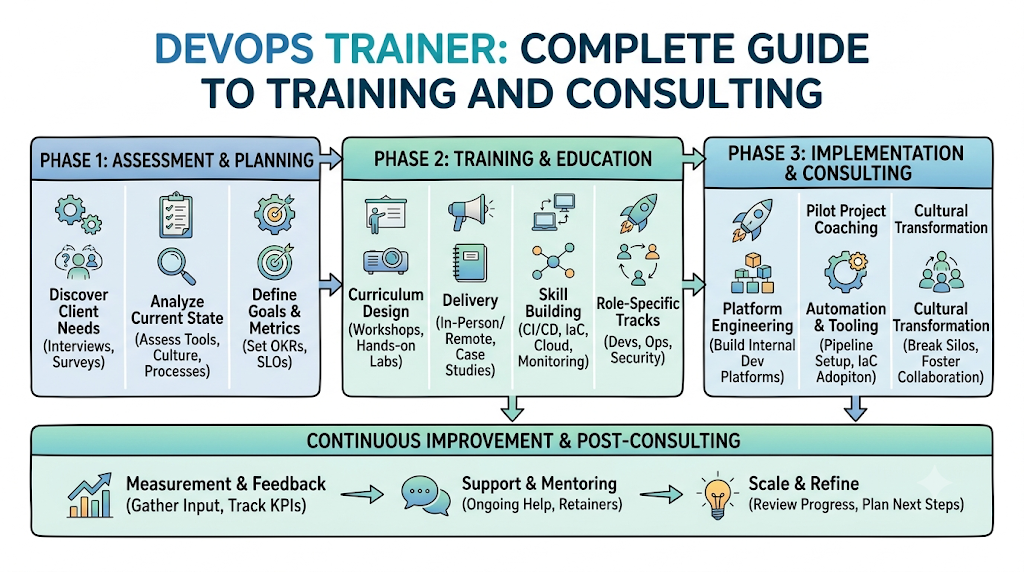
A DevOps Trainer is responsible for upskilling teams through curated learning paths, hands-on labs, and role-specific workshops. Their primary goal is to convert abstract concepts like CI/CD, Infrastructure as Code, and GitOps into practical habits your engineers can repeat confidently.A DevOps Consultant, in contrast, steps into your environment to diagnose bottlenecks, redesign delivery pipelines, introduce automation, and shape operating models. When one person operates in both capacities, you get a powerful combination: structured DevOps training to build skills and targeted consulting to embed those skills into day-to-day delivery.For organizations working with a DevOps Trainer in India who also acts as a Cloud DevOps Consultant, this usually spans CI/CD pipeline training, Docker Kubernetes training, Terraform training, Jenkins training, GitOps training, and cloud-native practices across AWS, Azure, and Google Cloud.
Why DevOps Is No Longer Optional
Software now underpins customer experiences, internal operations, and revenue streams. That means slow releases, frequent outages, or ad-hoc deployments quickly become business risks. DevOps addresses this by connecting development, operations, security, and platform teams through automation, feedback loops, and shared responsibility.When layered with Site Reliability Engineering training, DevSecOps corporate training, and Platform Engineering practices, DevOps ceases to be a “tooling upgrade” and becomes a predictable delivery engine. Organizations that combine DevOps corporate training with Cloud DevOps consulting often see improvements in deployment cadence, incident response, and overall reliability.
DevOps vs Traditional IT Delivery
DevOps vs Traditional IT
| Aspect | DevOps Approach | Traditional IT Approach |
|---|---|---|
| Features | Cross-functional collaboration, automated CI/CD, continuous feedback | Siloed teams, manual approvals, long release cycles |
| Benefits | Faster releases, higher agility, improved quality | Stability for slow-moving, low-change environments |
| Limitations | Requires mindset change, new skills, process redesign | Struggles to support cloud-native and rapid delivery requirements |
| Use Cases | Cloud-native apps, microservices, frequent deployments | Legacy systems, rarely updated applications |
| Best Choice | DevOps for modern digital products and services | Traditional for small, static systems with minimal change |
A DevOps Trainer helps teams move away from ticket-driven, handoff-heavy workflows toward automated, reliable pipelines. A DevOps Consultant then ensures that these changes are grounded in your specific compliance, security, and business constraints instead of generic templates.
DevOps Trainer vs DevOps Consultant
Two Perspectives, One Outcome
| Aspect | DevOps Trainer | DevOps Consultant |
|---|---|---|
| Features | Structured courses, labs, assessments, guided exercises | Environment assessment, architecture design, implementation support |
| Benefits | Builds a common knowledge base and shared vocabulary | Aligns technology, process, and people around a common roadmap |
| Limitations | Without real projects, knowledge can remain theoretical | Without training, improvements may depend on a few individuals |
| Use Cases | Onboarding new teams, reskilling, introducing new practices | Major transformations, cloud migration, platform modernization |
| Best Choice | Combine both roles to ensure learning translates into delivery |
In practice, the most effective engagements blend both roles: the trainer builds capability while the consultant ensures the organization’s systems and culture evolve in parallel.
Docker vs Kubernetes: Where the Kubernetes Trainer Adds Value
Containers vs Orchestration
| Aspect | Docker (Containers) | Kubernetes (Orchestration) |
|---|---|---|
| Features | Package apps and dependencies into portable containers | Manage clusters, scheduling, scaling, and self-healing of containers |
| Benefits | Consistent runtime across laptops, test, and production | Automated rollouts, rollbacks, high availability, multi-node resilience |
| Limitations | Limited built-in orchestration capabilities | Complex operations, steeper learning curve |
| Use Cases | Local development, simple workloads, single-node setups | Production microservices, multi-environment deployments, hybrid cloud |
| Best Choice | Pair Docker with Kubernetes for production; use Docker alone for small setups |
A Kubernetes Trainer helps teams make the leap from “we run Docker containers” to “we operate resilient Kubernetes clusters.” This typically includes Docker Kubernetes training, GitOps training with tools like ArgoCD or FluxCD, and Infrastructure as Code using Terraform to manage clusters and cloud resources.
Core Roles: DevOps, Kubernetes, SRE, DevSecOps, Platform Engineering
A versatile expert may perform several roles: DevOps Trainer, Kubernetes Trainer, SRE Trainer, DevSecOps Trainer, Platform Engineering Consultant, and Cloud DevOps Consultant. This multi-disciplinary view is critical when organizations want a coherent strategy instead of scattered initiatives.
- As a DevOps Trainer, the emphasis is on CI/CD pipelines, automation, and tools like Jenkins, GitHub Actions, and Azure DevOps.
- As a Kubernetes Trainer, the focus is on cluster architecture, deployments, networking, storage, security, and troubleshooting.
- As an SRE Trainer and SRE Consultant, the work centers around SLIs, SLOs, error budgets, incident management, and observability.
- As a DevSecOps Trainer, the objective is to embed security controls, scanning, and policy-as-code into pipelines.
- As a Platform Engineering Consultant, the mission is to build internal developer platforms that standardize infrastructure and enable self-service.
This integration ensures that DevOps, SRE, DevSecOps, and Platform Engineering complement each other instead of competing for attention.
Training Roadmap: From Basics to Advanced DevOps
A good DevOps training program avoids “tool dumps” and follows an intentional progression that connects fundamentals to advanced capabilities.
Stage 1 – Foundations
The journey usually begins with fundamentals: Linux basics, command-line fluency, shell scripting, networking, and version control with Git. The goal is to ensure every participant can navigate systems, collaborate via Git, and understand the lifecycle of changes.
Stage 2 – Automation and CI/CD
Next comes automation. Teams learn Jenkins training concepts, CI/CD pipeline training, build pipelines, automated tests, and deployment workflows. Infrastructure as Code with Terraform and configuration management tools (for example, Ansible) follows soon after, creating reproducible environments instead of manual setups.
Stage 3 – Cloud and Kubernetes
The focus then shifts to cloud platforms and container orchestration. This often includes AWS DevOps consultant–led design sessions, Docker Kubernetes training, and hands-on labs for deploying services to managed or self-hosted clusters. GitOps training is introduced to ensure deployments are driven from version control rather than ad-hoc scripts.
Stage 4 – SRE, DevSecOps, and Platform Engineering
Finally, advanced topics integrate reliability, security, and platform thinking. Site Reliability Engineering training covers SLOs, SLIs, error budgets, and on-call practices. DevSecOps corporate training focuses on secure pipelines, automated checks, and compliance. Platform Engineering training teaches teams how to build shared platforms that simplify life for developers.
How a Cloud DevOps Consultant Engages with Your Organization
A Cloud DevOps Consultant typically adopts a phased, outcome-driven approach rather than jumping straight into tools.
Assessment and Discovery
The engagement begins with understanding current systems: existing pipelines, release processes, cloud usage, security posture, incident history, and organizational structure. This step identifies both quick wins and systemic issues.
Strategy and Roadmap
Based on the assessment, the consultant defines a roadmap. This may include standardizing CI/CD pipelines, migrating to containerized workloads, introducing Infrastructure as Code, implementing observability, or building an internal platform. Timelines and priorities are aligned with business goals, budgets, and constraints.
Implementation and Coaching
Implementation blends hands-on work with coaching. The consultant works alongside internal teams to build pipelines, set up Kubernetes clusters, introduce GitOps, strengthen security, and refine incident response. Continuous coaching ensures knowledge is transferred and teams become self-sufficient, not dependent on external help.
DevOps, DevSecOps, and SRE: How They Fit Together
DevOps vs DevSecOps vs SRE
| Aspect | DevOps | DevSecOps | SRE |
|---|---|---|---|
| Features | Integrates dev and ops, emphasizes automation and CI/CD | Embeds security throughout the DevOps lifecycle | Treats operations as code, focuses on reliability |
| Benefits | Faster change delivery, better collaboration | Reduced security risk, earlier detection of vulnerabilities | Higher uptime, controlled error budgets |
| Limitations | May underemphasize security and reliability specialties | Requires strong collaboration between security and engineering | Requires mature tooling and engineering culture |
| Use Cases | Digital products, APIs, web/mobile applications | Regulated industries, data-sensitive systems | High-availability services, mission-critical platforms |
| Best Choice | Implement all three as complementary practices |
A DevSecOps Trainer and SRE Trainer ensure that security and reliability are built into design, development, and operations from day one. Instead of bolting security on at the end or treating reliability as “ops work,” teams adopt a shared, measurable approach.
Best Practices for DevOps, Kubernetes, and SRE Success
Organizations that succeed with DevOps and cloud-native strategies tend to follow a set of consistent patterns:
- Tie DevOps initiatives to explicit business outcomes: faster releases, fewer incidents, or better auditability.
- Invest in DevOps corporate training and Kubernetes corporate training to align teams on language, practices, and expectations.
- Standardize pipelines and Infrastructure as Code (using Jenkins, GitHub Actions, Terraform, etc.) across teams to avoid one-off solutions.
- Introduce observability early by instrumenting logs, metrics, and traces; this pays off as systems grow in complexity.
- Use Site Reliability Engineering training to establish SLIs, SLOs, and error budgets, making reliability a measurable objective.
- Integrate security from the beginning via DevSecOps training and automated checks in CI/CD pipelines.
- Use Platform Engineering principles to create shared, reusable components instead of every team reinventing the wheel.
With guidance from a DevOps Trainer and Cloud DevOps Consultant, these practices evolve from isolated experiments to organization-wide standards.
Common Pitfalls in DevOps and Cloud Adoption
Adoption often fails not because teams are incapable, but because strategy, communication, or scope are mismanaged. Some frequent mistakes include:
- Treating DevOps as a tool installation project rather than a cultural and process transformation.
- Jumping into Jenkins, Docker, or Kubernetes without clarifying how they support business goals.
- Expecting teams to “learn on the fly” in production without dedicated training and structured practice.
- Ignoring security and compliance until after incidents or audits force reactive fixes.
- Running Kubernetes without clear capacity planning, observability, or incident playbooks.
- Building fragile, one-off pipelines instead of platform-style services that can be reused.
An experienced DevOps Trainer in India with strong consulting experience helps organizations sidestep these pitfalls by providing both structure and practical guidance.
Expert Tips from the Field
Drawing from multiple DevOps, SRE, DevSecOps, and Platform Engineering engagements, here are practical tips that consistently work:
- Design pipelines around business value streams rather than individual tools or teams.
- Treat Infrastructure as Code as the canonical source for environments; avoid manual changes whenever possible.
- Standardize deployment strategies (rolling, blue-green, canary) and document them clearly for all teams.
- Use GitOps to manage cluster and application configuration through Git, improving traceability and rollback.
- Combine Site Reliability Engineering training with real postmortems and blameless incident reviews to build learning culture.
- Start Platform Engineering with a minimal platform that solves a few high-value use cases instead of a massive big-bang project.
- Integrate security checks (SAST, DAST, dependency scanning) into pipelines so they run automatically and consistently.
These tips are not theoretical—they emerge from real-world successes and failures across diverse organizations and technology stacks.
Corporate Training vs Self-Learning
Two Paths to Skill Development
| Aspect | Corporate Training | Self-Learning |
|---|---|---|
| Features | Instructor-led sessions, labs, tailored scenarios, team-focused | Self-paced courses, online tutorials, books, community resources |
| Benefits | Aligns multiple teams around consistent practices, stack-specific content | Flexible scheduling, broad exposure to tools and concepts |
| Limitations | Requires coordination, budget, and internal champions | Inconsistent depth, varied quality, hard to standardize across orgs |
| Use Cases | Large-scale upskilling, new strategic initiatives, platform rollouts | Individual learning, early exploration of new technologies |
| Best Choice | Corporate training as the foundation, self-learning for continued growth |
DevOps corporate training led by an experienced DevOps Trainer ensures a consistent baseline. Self-learning then builds on this foundation, allowing individuals to dive deeper into specific tools or specializations.
Why Learn from a Practitioner-Trainer
Learning DevOps, Kubernetes, SRE, DevSecOps, and Platform Engineering from someone who has only theoretical knowledge is risky. Real-world experience matters—especially when dealing with outages, incident management, compliance, and large-scale architecture.A practitioner-trainer can share what worked, what failed, and why, across different industries. They adapt explanations for developers, operations, security teams, management, and leadership. They also design labs rooted in realistic case studies: production incidents, complex rollouts, cost overruns, and security findings—helping teams connect training content with their own daily challenges.
Why Engage Rajesh Kumar for DevOps, Kubernetes, SRE, and DevSecOps
Rajesh Kumar brings a combination of DevOps, SRE, DevSecOps, CloudOps, and Platform Engineering expertise, backed by extensive corporate training and consulting engagements. He has delivered numerous DevOps corporate training programs and mentored a large number of professionals across geographies and industries.As a Principal Architect and trainer, he is comfortable navigating both high-level strategy and deep technical implementation. Whether it’s Jenkins training, Docker Kubernetes training, Terraform training, GitOps workflows, or Cloud DevOps consulting on AWS, Azure, and Google Cloud, he focuses on pragmatic, repeatable solutions rather than one-off fixes.
Frequently Asked Questions (15)
1. What is the main purpose of a DevOps Trainer?
A DevOps Trainer’s main purpose is to build practical skills in areas like CI/CD, automation, cloud deployment, and observability. They design structured programs with labs and exercises so participants can repeatedly apply what they learn in real environments.
2. How is a DevOps Consultant different from our existing engineers?
A DevOps Consultant brings a wider set of experiences from multiple organizations and domains. They focus on diagnosing systemic issues, designing target operating models, and guiding transformation, rather than just maintaining one pipeline or system.
3. Why should we consider DevOps corporate training instead of just online courses?
DevOps corporate training aligns content with your tech stack, domain, and goals. It allows teams to ask context-specific questions, work through tailored exercises, and leave with practices they can implement immediately, which is harder to achieve through generic online content alone.
4. What topics are typically included in Kubernetes corporate training?
Kubernetes corporate training generally covers cluster architecture, pods, deployments, services, networking, storage, security, scaling, observability, and troubleshooting. It often extends to GitOps workflows, CI/CD integration, and cloud provider–specific features to mirror production scenarios.
5. How does Site Reliability Engineering training benefit operations teams?
Site Reliability Engineering training helps operations teams think in terms of service-level objectives, error budgets, and production readiness. It shifts focus from purely reactive firefighting to proactive reliability engineering and continuous improvement of systems and processes.
6. What does a DevSecOps Trainer usually focus on?
A DevSecOps Trainer focuses on integrating security into every phase of the delivery pipeline. This includes secure coding principles, automated scanning, secrets management, compliance checks, and policy-as-code, ensuring that security becomes part of the pipeline rather than an afterthought.
7. Who should attend Platform Engineering Training?
Platform Engineering Training is ideal for engineers responsible for infrastructure, internal tooling, and developer experience. It’s also valuable for technical leads and architects who want to design internal platforms that provide self-service capabilities and consistent pipelines for multiple teams.
8. How do Cloud DevOps consulting engagements typically begin?
Cloud DevOps consulting engagements usually start with discovery sessions, architectural reviews, and an inventory of existing pipelines, tools, and environments. This baseline allows the consultant to craft a pragmatic roadmap that balances quick wins with longer-term improvements.
9. Can DevOps corporate training be tailored to our existing tools?
Yes, customized DevOps corporate training can be built around your existing stack—whether you use Jenkins, GitHub Actions, Bitbucket, Terraform, Ansible, AWS, Azure, or Google Cloud. This ensures examples, labs, and discussions are directly relevant to your day-to-day work.
10. How fast can we expect results from DevOps training and consulting?
Some improvements, like more reliable pipelines or better deployment practices, can appear within weeks. Cultural shifts, process changes, and platform engineering efforts take longer, often months, but combining training with ongoing consulting accelerates the overall journey.
11. Which automation tools should we prioritize initially?
Most organizations start with Git for version control, a CI/CD tool like Jenkins or GitHub Actions, Terraform for Infrastructure as Code, and Docker plus Kubernetes for containerization. The exact mix depends on existing investments and long-term platform strategy.
12. What role does GitOps play in a DevOps strategy?
GitOps formalizes the idea that all changes go through Git-based workflows, which improves auditability, consistency, and rollback capabilities. It works particularly well with Kubernetes, where cluster and application states can be managed declaratively via Git.
13. Is DevOps suitable for highly regulated environments?
DevOps can be a strong fit for regulated environments when combined with robust DevSecOps practices. Automation, logging, and policy-as-code improve traceability and compliance, often making regulated systems safer and more auditable than manual, spreadsheet-driven processes.
14. What should we look for when choosing a DevOps Trainer in India?
Look for a trainer with practical project experience, a track record of corporate training, and fluency across tools like Jenkins, Terraform, Kubernetes, and major clouds. Client references, published content, and past engagements are good indicators of credibility.
15. Can one expert cover DevOps, Kubernetes, SRE, and DevSecOps?
Yes, some practitioners develop deep, broad experience across these domains over many years. Such experts can provide cohesive strategies and training programs that ensure DevOps, SRE, DevSecOps, and Platform Engineering reinforce each other rather than becoming fragmented initiatives.
Conclusion
DevOps, Kubernetes, SRE, DevSecOps, and Platform Engineering together form the backbone of modern software delivery. The challenge is not acquiring tools, but building sustainable practices, cultures, and platforms that support continuous change. Partnering with an experienced DevOps Trainer and DevOps Consultant gives organizations a structured path: training to build capability, consulting to anchor those capabilities in real systems, and ongoing guidance to keep evolving. For teams serious about reliability, security, and speed, this combination is no longer a luxury—it’s a necessity.
