Future driven IT security learning with Certified DevSecOps Engineer Certification
Introduction
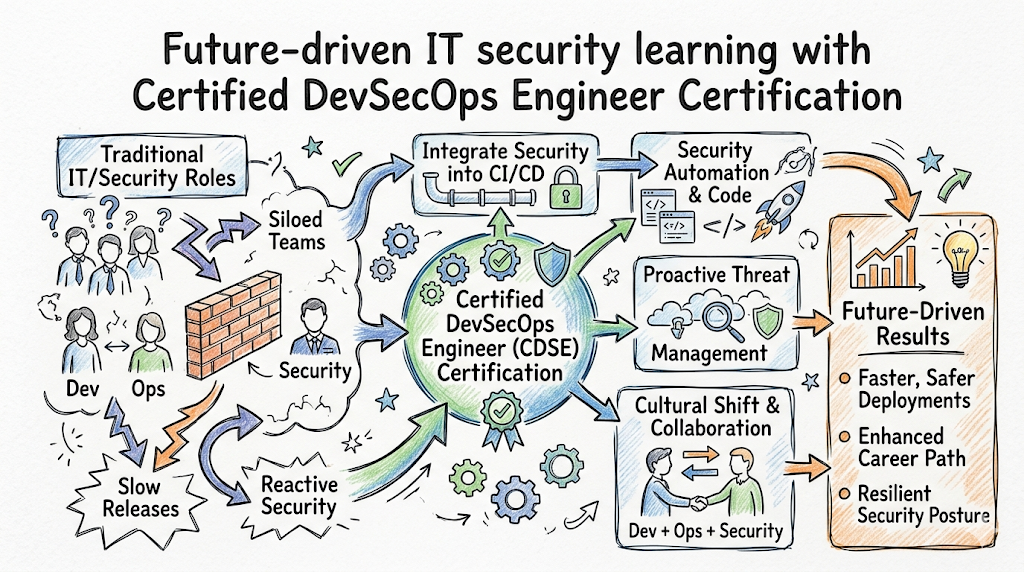
Software teams today release new features very fast. With every new release, new security risks can also come in. Because of this, companies now want engineers who can mix development, operations, and security in one smooth flow.The Certified DevSecOps Engineer certification is made for people who want to build and run pipelines that are both fast and safe in real life.
What it is
Certified DevSecOps Engineer is a professional certification that proves you know how to add security into every step of the DevOps lifecycle.
It covers how to design, build, and run secure pipelines using scanners, policies, automation, and good processes.
The focus is on doing DevSecOps in real projects, not only answering exam questions.
Who should take it
This certification is a good choice for:
- DevOps engineers who want strong security skills along with CI/CD and cloud.
- System administrators and cloud engineers moving towards DevOps or platform roles.
- Security engineers who want to understand pipelines, automation, and release workflows.
- SREs and platform engineers who run production systems and care about secure operations.
- Developers who handle build pipelines or deployment and want to “shift security left.”
If you care about both speed of delivery and safety of systems, Certified DevSecOps Engineer is designed for you.
Certified DevSecOps Engineer – Certification overview
The Certified DevSecOps Engineer program is built around real DevSecOps activities.
It teaches you how to secure code, pipelines, images, infrastructure, and running systems in a simple but powerful way.Typical coverage includes:
- DevSecOps basics and secure SDLC.
- Secure CI/CD design and hardening.
- Vulnerability management and security testing.
- Container and Kubernetes security foundations.
- Cloud security basics for DevOps engineers.
- Secrets management and policy‑as‑code.
The idea is that after this program, you should be able to open any pipeline and say: “I know where to put checks, how to handle alerts, and how to keep this flow secure without breaking the team’s speed.”
Program delivery, levels, assessment, and structure
The program is delivered via the official Certified DevSecOps Engineer course (same URL as above) and is hosted on the DevSecOpsSchool website.In simple words, here is how it usually works:
- Course delivery:
- Online training for working professionals.
- Instructor‑led or self‑paced videos plus guided labs where you work with real tools and pipelines.
- Levels and structure:
- Starts with foundations: DevSecOps concepts, secure SDLC, “shift‑left” thinking.
- Moves into implementation: CI/CD integration, secrets management, container security, infrastructure as code checks.
- Ends with advanced practice: monitoring, incident handling, compliance automation, and improvement loops.
- Assessment approach:
- A final exam to check understanding of important DevSecOps topics and scenarios.
- In many cases, hands‑on or scenario‑based tasks where you solve real‑style security problems in demo environments.
- Ownership:
- DevSecOpsSchool owns and maintains the syllabus, exam, and certification process.
- Industry experts keep the content updated with new tools, threats, and best practices.
For you, this simply means: enroll in the course, complete modules and labs, pass the exam, and receive your Certified DevSecOps Engineer certificate.
Skills you will gain
After completing this certification, you can expect to gain skills such as:
- Understanding of DevSecOps principles and how they extend DevOps.
- Ability to integrate SAST, DAST, and SCA tools into CI/CD pipelines.
- Skills to secure build agents, code repositories, and deployment targets.
- Knowledge of secrets management and safe handling of tokens, keys, and passwords.
- Practical experience with container and basic Kubernetes security.
- Ability to automate security tests and checks in pipelines.
- Understanding of vulnerability lifecycle: detection, triage, fixing, and tracking.
- Basic awareness of compliance and how to automate policy checks.
- Confidence in reading security reports and deciding what to fix first.
Real‑world projects you should be able to do after it
After this certification, you should be ready to handle real tasks like:
- Taking an existing pipeline and adding code, dependency, and image scanning.
- Setting up rules to block releases when critical vulnerabilities are found.
- Implementing secure secrets management for applications and pipelines.
- Writing or using policies to check infrastructure as code templates.
- Creating simple dashboards for security findings per service or environment.
- Hardening CI/CD servers and runner machines.
- Adding automated security checks on pull requests and merges.
- Working with developers and security to tune rules and reduce noise.
These are the types of activities real DevSecOps engineers are expected to manage in modern teams.
Common mistakes professionals make
Many teams try DevSecOps but make common mistakes that reduce impact.
This certification helps you understand and avoid issues such as:
- Turning on scanners but never fixing or triaging the results.
- Making pipelines fail too often without clear communication to developers.
- Keeping secrets in code, plain text files, or unprotected variables.
- Focusing only on code scanning and ignoring containers and runtime.
- Treating DevSecOps as a one‑time project instead of continuous improvement.
- Skipping documentation of pipeline flows and security rules.
- Not tracking metrics like vulnerability age, closure time, and coverage.
A good DevSecOps engineer builds security that teams actually use and trust every day.
Best next certification after this
After Certified DevSecOps Engineer, your best “next” step depends on your goal:
- If you want deeper DevSecOps, choose an architect‑level DevSecOps or security architecture certification.
- If you want broader operations and reliability, pick SRE or platform engineering certifications.
- If you want more leadership and strategy, go for architecture or technical leadership certifications.
You can mix these directions over time to design your own long‑term roadmap.
Certified DevSecOps Engineer – Certification table
| Track | Level | Who it’s for | Prerequisites | Skills Covered | Recommended Order | Official Link |
|---|---|---|---|---|---|---|
| DevSecOps | Engineer / Professional | DevOps, security, SRE, platform, and cloud engineers | Basic DevOps, Linux, CI/CD, basic security awareness | Secure CI/CD, vulnerability management, secrets, container security | After DevOps or DevSecOps fundamentals | Certified DevSecOps Engineer official certification page |
Choose your path – 6 learning paths
You can place this certification inside a bigger career plan using these paths:
- DevOps path
Start with DevOps basics, then DevOps professional‑level certifications, and use Certified DevSecOps Engineer to add security to your DevOps profile. - DevSecOps path
Learn DevOps foundations, then DevSecOps basics, complete Certified DevSecOps Engineer, and later grow into DevSecOps architect or cloud security roles. - SRE path
Combine DevSecOps Engineer with SRE training so you can manage reliability, performance, and security together in production environments. - AIOps / MLOps path
Use your DevSecOps background to work with monitoring and AI‑driven operations, automating detection and response for incidents and security events. - DataOps path
Apply DevSecOps ideas to data pipelines and analytics platforms, focusing on secure, governed data movement. - FinOps path
Combine DevSecOps with FinOps skills so you can design cloud systems that are secure, reliable, and cost‑efficient at the same time.
Role → Recommended certifications mapping
| Role | Recommended certifications (including DevSecOps Engineer) |
|---|---|
| DevOps Engineer | DevOps Foundation → DevOps Professional → Certified DevSecOps Engineer |
| SRE | DevOps or SRE Foundation → SRE‑focused cert → Certified DevSecOps Engineer |
| Platform Engineer | Kubernetes or cloud platform certs → platform engineering → Certified DevSecOps Engineer |
| Cloud Engineer | Cloud provider certs → CI/CD and containers → Certified DevSecOps Engineer |
| Security Engineer | Security fundamentals → app or cloud security → Certified DevSecOps Engineer |
| Data Engineer | Data or cloud fundamentals → DataOps‑oriented courses → Certified DevSecOps Engineer |
| FinOps Practitioner | Cloud or FinOps certs → governance and cost control → Certified DevSecOps Engineer |
| Engineering Manager | DevOps or agile leadership → Certified DevSecOps Engineer → architecture or strategy‑level certs |
Top institutions supporting training and certification
These institutions and platforms can help you with training, labs, and guidance for Certified DevSecOps Engineer and related paths:
- DevOpsSchool – Focused on DevOps, DevSecOps, and SRE training with hands‑on labs, practice projects, and clear certification roadmaps.
- Cotocus – A consulting and training group with real project experience in DevOps and security, bringing field knowledge into the classroom.
- ScmGalaxy – A long‑time training platform for build, release, and DevOps, covering many tools and practices.
- BestDevOps – A resource hub and community for DevOps‑related content, training, and career development, including security‑focused roles.
- Devsecopsschool.com – The official site for multiple DevSecOps certifications, including Certified DevSecOps Engineer. It hosts the syllabus, updates, and exam information.
- Sreschool – A platform centered on Site Reliability Engineering, connecting reliability, monitoring, and security for modern cloud systems.
- Aiopsschool – Focused on AIOps, combining AI, automation, and operations, where DevSecOps knowledge is very useful.
- Dataopsschool – Training dedicated to DataOps, data platforms, and secure data workflows.
- Finopsschool – A platform for FinOps training, helping teams manage cloud cost alongside performance and security.
Next certifications to take (3 options)
After Certified DevSecOps Engineer, you can choose:
- Same track – Deep DevSecOps
Go for DevSecOps architect or advanced security architecture certifications to design organization‑wide security strategy. - Cross‑track – Broader skills
Choose SRE, platform engineering, AIOps, DataOps, or FinOps certifications to become a multi‑skill engineer across security, reliability, data, and cost. - Leadership – Strategy and management
Pick leadership or architecture‑oriented certifications that teach you how to design roadmaps, manage teams, and lead DevSecOps transformations.
FAQs on Certified DevSecOps Engineer
Q1. What is the main focus of the Certified DevSecOps Engineer certification?
The main focus is to help you integrate practical security controls into real DevOps pipelines, from code and build to deploy and run.
It proves that you can work with real tools and scenarios, not just memorize theory.Q2. Do I need strong coding skills for this certification?
You should be comfortable with basic scripts, configuration files, and DevOps tools, but you do not need to be a full‑time application developer.
The emphasis is more on pipelines and automation than on complex application code.Q3. What background should I have before starting?
You should know basic DevOps concepts like CI/CD, Git, Linux, and simple cloud ideas.
If you are new to DevOps, start with a foundation‑level DevOps course before attempting this certification.Q4. How is this different from a traditional security certification?
Traditional security certifications often focus on audits, risk, or penetration testing.
Certified DevSecOps Engineer focuses on embedding security into the everyday work of building, testing, and deploying software.
Q5. Is this useful for SREs and platform engineers?
Yes, because SREs and platform engineers own production systems where security and reliability meet.
This certification helps them design platforms that are safe, stable, and fast.
Q6. How long does preparation usually take?
For working professionals with some DevOps background, preparation often takes a few weeks to a couple of months, depending on your schedule.
Regular hands‑on practice with pipelines and security tools will speed up your learning.Q7. What type of hands‑on practice is recommended?
You should practice integrating scanners into pipelines, managing secrets, hardening CI/CD runners, and testing small applications in secure environments.
The more real scenarios you touch, the more confident you will feel.Q8. What roles can this certification help me reach?
This certification is useful for DevSecOps Engineer, Senior DevOps Engineer, Cloud Security Engineer, SRE, and Platform Engineer roles.
Why choose DevOpsSchool?
DevOpsSchool is known for practical, hands‑on training across DevOps, DevSecOps, SRE, and related areas.
Its DevSecOps programs are built around real tools, real pipelines, and real examples, not just slides.With DevOpsSchool you usually get:
- Structured courses that start from basics and go to advanced topics.
- Lab‑based learning where you actually configure pipelines, scanners, and cloud resources.
- Help with career planning, exam preparation, and applying skills in real jobs.
If you are serious about building a long‑term DevSecOps career, DevOpsSchool is a strong training partner and learning home.
Conclusion
Certified DevSecOps Engineer is a powerful certification for anyone who wants to make security a normal, natural part of software delivery.
It teaches you how to secure pipelines, manage vulnerabilities, and work closely with developers, operations, and security teams.For DevOps engineers, security specialists, SREs, and engineering managers, this certification opens doors to modern, high‑impact roles.
With the right training and a clear roadmap across DevOps, DevSecOps, SRE, AIOps, DataOps, and FinOps, it can become a strong pillar of your technology career.
