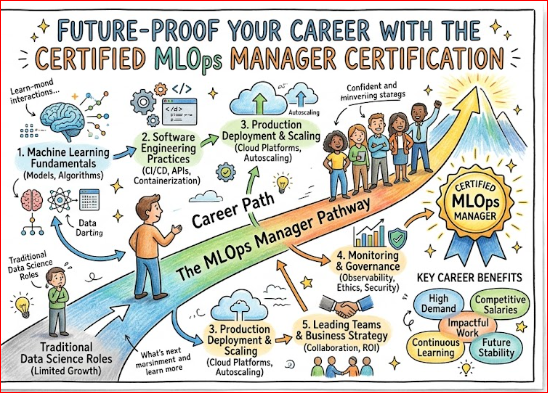
Future-proof your career with the Certified MLOps Manager certification
Introduction
Certified MLOps Manager is a modern certification for professionals who want to manage machine learning (ML) projects in a real-world production environment. It focuses on how to combine data science, DevOps, and cloud practices to build, deploy, and manage ML models at scale in a stable and secure way. This certification helps you move from “just building models” to “running ML systems that work in production every day.”
What it is
Certified MLOps Manager is a professional credential that proves you understand how to design, deploy, monitor, and improve ML systems in production. It focuses on real-world practices like pipelines, CI/CD, data quality, model governance, observability, and automation. The goal is to help you run ML like a stable, secure product instead of a one-time experiment.
Who should take it
Certified MLOps Manager is ideal for:
- ML engineers who want to move from pure coding to full lifecycle ownership.
- Data scientists who want to understand deployment, scaling, and operations.
- DevOps / SRE / Platform engineers who support ML workloads and want to add MLOps skills.
- Technical leads and managers who own ML platforms and need a structured way to run ML in production.
- Cloud and data engineers who build infrastructure for data and models and want to standardize MLOps practices.
Certified MLOps Manager Certification Overview
Certified MLOps Manager is designed as a hands-on, practical certification focused on how ML actually runs in production across different industries. It teaches you how to create repeatable pipelines, manage model versions, handle environments, and ensure that models stay reliable over time. You learn how to work with data teams, DevOps teams, and business teams to deliver ML features faster and more safely.This certification also stresses governance, security, and observability. You learn how to document models, track changes, manage access, and keep an eye on model performance, data drift, and system health. At the end of the program, you should be able to act as the “bridge” between data science and operations so that ML projects do not die after the first release.
Program delivery and structure
The Certified MLOps Manager program is delivered via a dedicated course (hosted on AIOpsSchool’s official training website) that combines theory, labs, and real-world case studies. The course is offered as guided online training with instructor-led sessions, recorded material, hands-on exercises, and project-based assignments. You learn using practical tools and workflows that you can apply directly in your job.The certification usually follows a single core level focused on practical MLOps management rather than many confusing tiers. You may have a standard “Certified MLOps Manager” level for practitioners, and then advanced or leadership options as separate programs. The assessment approach is typically a mix of scenario-based questions, practical tasks, and project reviews, so it tests what you can actually do instead of only what you can memorize.Ownership of the certification stays with the provider (AIOpsSchool), which defines the syllabus, updates the curriculum, and runs the exams. The structure is simple: enroll in the official course, complete the training, finish the projects, and pass the assessment to earn the credential. Recertification or upskilling can be done by taking advanced modules or related certifications in areas like AIOps, DataOps, and FinOps.
Skills you’ll gain
- Understanding of the full ML lifecycle from data to deployment
- Designing and managing ML pipelines and workflows
- Implementing CI/CD for ML models and data pipelines
- Handling data versioning, feature stores, and model registries
- Working with ML platforms on cloud or on-prem environments
- Setting up monitoring for model performance and data drift
- Applying observability practices (logs, metrics, traces) for ML systems
- Implementing model governance, documentation, and approvals
- Managing security and access in ML environments
- Collaborating with data scientists, DevOps, and business teams
- Planning capacity, performance, and cost optimization for ML workloads
- Managing rollout strategies (A/B tests, canary releases, shadow deployments)
- Handling incident response and rollback for ML failures
- Aligning ML workflows with compliance and audit needs
Real-world projects you should be able to do after it
- Build and manage an end-to-end ML pipeline that trains, tests, and deploys models automatically.
- Set up a model registry, version models, and manage different environments (dev, test, prod).
- Implement CI/CD for ML using tools like Git, pipelines, and container-based deployments.
- Configure monitoring dashboards that track accuracy, latency, drift, and business KPIs.
- Design an incident response flow for ML failures, with rollback and re-training triggers.
- Integrate ML systems with existing microservices, APIs, and data platforms.
- Plan and execute a migration of a manual ML workflow into a fully automated MLOps setup.
- Create documentation and governance workflows for models to satisfy audits and reviews.
Common mistakes
- Treating ML as a one-time project instead of an ongoing product.
- Ignoring data quality and versioning, which leads to unstable models in production.
- Deploying models manually without proper CI/CD and rollback strategies.
- Focusing only on accuracy and ignoring latency, scalability, and cost.
- Not setting up monitoring for drift, leading to silent model failures.
- Using ad-hoc scripts instead of standardized pipelines and platforms.
- Neglecting security and access control for model artifacts and data.
- Forgetting to involve stakeholders, resulting in misaligned expectations.
Best next certification after this
After Certified MLOps Manager, a powerful next step is to specialize based on your role and career goals. If you want to go deeper into automation and reliability, a certification in AIOps or SRE can help you improve resilience and observability for ML-powered systems. If you want a broader view of data platforms, a DataOps or cloud-native certification can help you manage end-to-end data infrastructure for ML and analytics.
Complete Topic name Certification TableCertified MLOps Manager – Track and Level Overview
| Track | Level | Who it’s for | Prerequisites | Skills Covered | Recommended Order | Official Link |
|---|---|---|---|---|---|---|
| AIOps/MLOps | Practitioner | ML engineers, data scientists, MLOps managers | Basic ML knowledge, scripting, Linux, cloud basics | ML pipelines, CI/CD for ML, monitoring, governance, model lifecycle | Start here | https://aiopsschool.com/certifications/certified-mlops-manager.html |
| AIOps/MLOps | Advanced (optional) | Senior engineers, platform leads | Certified MLOps Manager or equivalent experience | Advanced automation, AIOps integration, multi-tenant ML platforms | After practitioner | Official advanced AIOps/MLOps programs (from AIOpsSchool) |
| AIOps/MLOps | Leadership (optional) | Engineering managers, heads of data and ML | Experience leading ML/DevOps teams | Strategy, governance, platform roadmaps, cross-team collaboration | After practical levels | Leadership and management-focused programs from AIOpsSchool |
Choose your path – 6 learning paths
DevOps
A DevOps path focuses on automation, CI/CD, infrastructure as code, and continuous delivery for applications and services. You learn how to manage pipelines, environments, and deployment strategies. Certified MLOps Manager fits well here because it extends DevOps practices into the ML domain, helping you handle model deployments along with standard application releases.
DevSecOps
The DevSecOps path centers on building security into every stage of the lifecycle. You learn about security scanning, compliance, and secure pipelines. Certified MLOps Manager complements this by teaching how to secure ML models, data, and pipelines, ensuring that ML workloads follow the same security standards as other systems.
SRE
An SRE path focuses on reliability, observability, and incident management. You learn error budgets, SLOs, monitoring, and operations at scale. With Certified MLOps Manager, you can apply SRE thinking to ML systems by adding SLOs for model performance, tracking drift, and designing robust recovery strategies for data and model failures.
AIOps/MLOps
The AIOps/MLOps path is about applying AI to operations and managing ML systems in production. Certified MLOps Manager sits at the heart of this path. You learn how to automate ML workflows, integrate with observability platforms, and use AI to enhance monitoring and incident response.
DataOps
The DataOps path focuses on data pipelines, data quality, and collaboration across data teams. You learn how to manage data flows, version control, testing, and governance. Certified MLOps Manager builds on DataOps principles by connecting them with model training, deployment, and monitoring, so data and models stay in sync.
FinOps
The FinOps path is about cloud cost management and financial accountability for engineering and data workloads. You learn how to track, optimize, and govern cloud spending. When combined with Certified MLOps Manager, you can design ML systems that are not only stable and accurate but also cost-efficient, with clear visibility into model and pipeline costs.
Role → Recommended certifications mappingRole-based Certification Mapping
| Role | Recommended Certifications |
|---|---|
| DevOps Engineer | DevOps fundamentals, cloud DevOps certification, Certified MLOps Manager |
| SRE | SRE certification, observability/monitoring certification, Certified MLOps Manager |
| Platform Engineer | Kubernetes/platform certification, infrastructure as code certification, Certified MLOps Manager |
| Cloud Engineer | Cloud provider certification (AWS/Azure/GCP), DevOps/AIOps certification, Certified MLOps Manager |
| Security Engineer | DevSecOps certification, cloud security certification, Certified MLOps Manager |
| Data Engineer | Data engineering certification, DataOps certification, Certified MLOps Manager |
| FinOps Practitioner | FinOps certification, cloud cost management certification, Certified MLOps Manager |
| Engineering Manager | Leadership certification, Agile/DevOps leadership programs, Certified MLOps Manager |
List of top institutions for Certified MLOps Manager training and certifications
There are several specialized institutions that provide training and support for certification programs related to DevOps, AIOps, and MLOps, including preparation for a Certified MLOps Manager–type role. DevOpsSchool offers structured training, hands-on labs, and blended learning options to build strong practical skills. Cotocus focuses on consulting and corporate training, helping teams adopt modern DevOps and MLOps practices in real projects. Scmgalaxy provides workshops, bootcamps, and online courses that cover tooling, pipelines, and automation for DevOps and related domains. BestDevOps curates content and training programs built around the latest DevOps and cloud-native trends, helping learners stay aligned with industry needs. Devsecopsschool brings a security-first approach, adding secure DevOps practices that are highly relevant for ML systems. Sreschool specializes in reliability engineering and operations, which are key for running ML in production. Aiopsschool, Dataopsschool, and Finopsschool give domain-specific training in AIOps, DataOps, and FinOps, helping you connect MLOps with data engineering, automation, and financial governance in a unified way.
Next certifications to take (3 options: same track, cross-track, leadership)
- Same track (MLOps / AIOps): An advanced MLOps or AIOps certification to go deeper into automation, event-driven architectures, and AI-powered observability.
- Cross-track: A DataOps, SRE, or DevSecOps certification to strengthen your understanding of pipelines, reliability, or security around ML systems.
- Leadership: A technology leadership, architecture, or engineering management certification to help you lead platform teams and drive MLOps adoption across the organization.
FAQs (10 questions & answers) on Certified MLOps Manager
Q1. What is Certified MLOps Manager?
Certified MLOps Manager is a professional certification that validates your skills in managing ML systems in production. It focuses on the complete lifecycle from data to deployment, monitoring, and governance.
Q2. Why should I pursue Certified MLOps Manager?
You should pursue this certification if you want to move beyond building models and learn how to run ML reliably in real environments. It can boost your profile for roles like MLOps engineer, ML platform owner, or technical lead for ML projects.
Q3. What background do I need before starting?
You should have basic knowledge of machine learning concepts, scripting or programming, and familiarity with Linux and cloud platforms. Experience with DevOps, data pipelines, or ML projects is helpful but not always mandatory.
Q4. How is the certification assessed?
Assessment is typically done through scenario-based questions, practical tasks, and project work. You may be asked to design pipelines, propose monitoring strategies, or explain how you would solve real-world MLOps challenges.
Q5. How long does it take to prepare?
Preparation time depends on your background. For someone with experience in ML or DevOps, a few weeks of focused study and hands-on practice might be enough. For beginners in MLOps, you may need more time to build confidence through projects and labs.
Q6. What tools are covered in the program?
The program usually focuses on concepts first and then uses common tools such as version control, CI/CD platforms, container technologies, and monitoring tools. The goal is to teach patterns that you can apply with different toolchains.
Q7. Is Certified MLOps Manager only for data scientists?
No, it is not only for data scientists. DevOps engineers, SREs, platform engineers, data engineers, and technical managers can all benefit because MLOps is a team sport that spans multiple roles.
Q8. Does the certification focus only on cloud?
Cloud is an important part, but the core ideas apply to both cloud and on-prem environments. The program teaches principles that can be applied on any infrastructure where ML is deployed.
Q9. Will this certification help in my career growth?
Yes, it can. Organizations are actively looking for professionals who can make ML work in production, not just in notebooks. This certification shows that you understand both ML and operations, which is a rare and valuable combination.
Q10. What should I do after passing Certified MLOps Manager?
After passing, you should apply the concepts to your current projects, contribute to platform improvements, and consider next certifications in AIOps, DataOps, SRE, or leadership. Continuous practice in real projects will make your knowledge stick.
Why choose AIOpsSchool?
AIOpsSchool focuses on building practical, job-ready skills for professionals who work at the intersection of AI, data, and operations. Its programs are designed with real-world use cases, hands-on labs, and scenario-based assignments that reflect how modern ML systems operate in production. You learn from trainers and practitioners who have experience with complex environments, including cloud, microservices, and large-scale data platforms. The curriculum stays aligned with industry trends so you are not just learning tools, but long-term patterns and best practices. AIOpsSchool also connects MLOps with related domains like AIOps, DataOps, and FinOps, giving you a broader view of how ML fits into the overall platform and business strategy.
Conclusion
Certified MLOps Manager is a powerful choice if you want to own the full lifecycle of machine learning systems and make them reliable, secure, and cost-effective in production. It helps you bridge the gap between data science and operations by teaching you how to design pipelines, set up CI/CD, manage models, and monitor performance in a structured and repeatable way. Whether you are a data scientist, DevOps engineer, or engineering manager, this certification can give you the vocabulary, tools, and confidence to lead ML initiatives that actually reach users and deliver value. By combining Certified MLOps Manager with related paths in AIOps, DataOps, SRE, and FinOps, you can build a strong, future-ready career around modern AI-driven platforms.
