Learn How IT Teams Manage Reliable Systems with Certified Site Reliability Engineer
Introduction
In today's fast-paced digital world, keeping systems running smoothly and reliably is more important than ever. Site Reliability Engineering (SRE) has become one of the most sought-after career paths for professionals who want to bridge the gap between development and operations. The Certified Site Reliability Engineer certification is designed to validate your skills in maintaining highly reliable and scalable systems while ensuring optimal performance.
What It Is
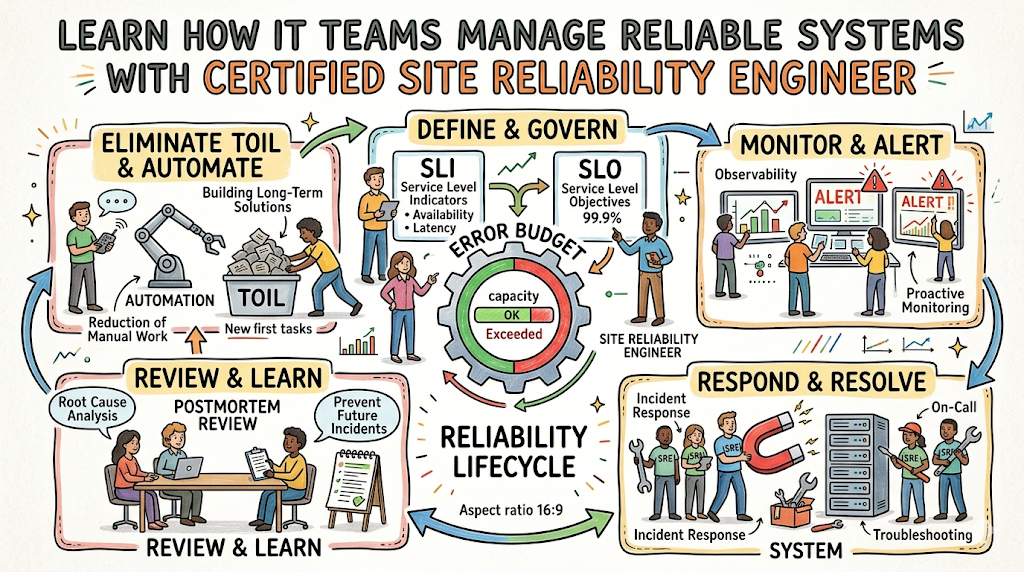
The Certified Site Reliability Engineer certification is a professional credential that proves your ability to design, implement, and manage reliable systems at scale. This certification covers essential SRE principles including monitoring, incident management, automation, capacity planning, and service level objectives. It teaches you how to balance the need for new features with system stability, using proven engineering practices that companies like Google have pioneered. The certification prepares you to handle real-world reliability challenges and implement best practices in production environments.
Who Should Take It
This certification is perfect for system administrators who want to advance their careers, software engineers looking to specialize in reliability, operations professionals seeking to modernize their skill set, DevOps engineers wanting to deepen their SRE knowledge, and IT professionals aiming to transition into high-demand SRE roles. Whether you're just starting in tech or looking to level up your existing skills, this certification provides a clear pathway to becoming a reliable systems expert.
Certified Site Reliability Engineer Certification Overview
The program is delivered via the Certified Site Reliability Engineer Course and hosted on SRESchool. The certification follows a single comprehensive level that covers foundational to advanced SRE concepts, making it accessible for beginners while challenging enough for experienced professionals.The assessment approach combines practical hands-on projects with knowledge-based evaluations to ensure you can apply SRE principles in real-world scenarios. The certification is owned and maintained by SRESchool, a leading provider of reliability engineering training. The structure includes modules on monitoring and observability, incident response and management, automation and tooling, capacity planning, service level indicators and objectives, error budgets, and reliability best practices. Each module builds upon the previous one, creating a logical learning progression that mirrors how SRE is practiced in production environments.
Skills You'll Gain
- Implementing comprehensive monitoring and alerting systems
- Designing and managing Service Level Indicators (SLIs) and Service Level Objectives (SLOs)
- Creating and maintaining error budgets for service reliability
- Automating toil and repetitive operational tasks
- Building incident response and post-mortem processes
- Performing capacity planning and performance optimization
- Implementing chaos engineering and resilience testing
- Managing on-call rotations and escalation procedures
- Developing disaster recovery and backup strategies
- Using observability tools like Prometheus, Grafana, and ELK stack
- Applying DevOps practices to improve system reliability
- Troubleshooting complex distributed systems issues
Real-World Projects You Should Be Able to Do After It
- Set up a complete monitoring stack with Prometheus and Grafana for a microservices application
- Design and implement SLOs and SLIs for a critical production service
- Create an automated incident response workflow with proper escalation procedures
- Build a comprehensive post-mortem process and template for your organization
- Implement chaos engineering experiments to test system resilience
- Develop automation scripts to eliminate toil in daily operations
- Design a capacity planning model based on historical data and growth projections
- Configure centralized logging and log analysis for distributed systems
- Create an on-call schedule and runbook for production services
- Implement automated rollback mechanisms for failed deployments
- Build dashboards that track key reliability metrics in real-time
- Design and test a disaster recovery plan for critical infrastructure
Common Mistakes
- Focusing only on theory without practicing on real systems and infrastructure
- Neglecting to understand the business impact of reliability decisions and trade-offs
- Treating SRE as just another operations role instead of an engineering discipline
- Ignoring the importance of soft skills like communication during incidents
- Not practicing incident response scenarios before facing real production issues
- Skipping the automation aspects and relying on manual processes
- Failing to create proper documentation and runbooks for team members
- Not understanding the relationship between SLOs, SLIs, and error budgets
- Overlooking the cultural aspects of SRE and focusing only on technical tools
- Trying to achieve 100% uptime instead of finding the right reliability balance
Best Next Certification After This
After completing the Certified Site Reliability Engineer certification, the Certified Kubernetes Administrator (CKA) is an excellent next step. Since modern SRE work heavily involves container orchestration and Kubernetes has become the industry standard, this certification will strengthen your ability to manage reliable containerized applications at scale. It complements your SRE skills by adding deep expertise in the platform where many reliability practices are implemented today.
Complete Certified Site Reliability Engineer Certification Table
| Track | Level | Who It's For | Prerequisites | Skills Covered | Recommended Order | Official Link |
|---|---|---|---|---|---|---|
| SRE | Comprehensive | System admins, DevOps engineers, operations professionals, software engineers | Basic Linux knowledge, understanding of networking concepts, familiarity with command line | Monitoring, SLOs/SLIs, incident management, automation, capacity planning, error budgets, observability, chaos engineering | 1st for SRE track | https://sreschool.com/certifications/certified-site-reliability-engineer.html |
Choose Your Path
1. DevOps Path
Start with foundational DevOps certifications, then move to Certified Site Reliability Engineer to specialize in reliability. Follow up with CI/CD and cloud platform certifications to complete your DevOps expertise.
2. DevSecOps Path
Begin with security fundamentals, add Certified Site Reliability Engineer to understand reliable secure systems, then pursue DevSecOps-specific certifications focusing on security automation and compliance.
3. SRE Path
Start directly with Certified Site Reliability Engineer as your foundation, then add Kubernetes and cloud certifications, followed by advanced monitoring and observability specializations.
4. AIOps/MLOps Path
Get your Certified Site Reliability Engineer certification first to understand production reliability, then move to machine learning operations certifications and AI-powered monitoring solutions.
5. DataOps Path
Combine Certified Site Reliability Engineer with data engineering certifications to manage reliable data pipelines, followed by specialized DataOps tools and practices.
6. FinOps Path
Start with cloud fundamentals and Certified Site Reliability Engineer to understand system efficiency, then add FinOps certifications focusing on cost optimization and financial management of cloud resources.
Role → Recommended Certifications Mapping
| Role | Recommended Certifications | Why These Certifications |
|---|---|---|
| DevOps Engineer | Certified Site Reliability Engineer, AWS/Azure DevOps, Docker & Kubernetes | Builds complete DevOps skillset with strong reliability foundation |
| SRE | Certified Site Reliability Engineer, CKA, Prometheus Certified | Core SRE skills plus container and monitoring expertise |
| Platform Engineer | Certified Site Reliability Engineer, Terraform Associate, Kubernetes | Enables building reliable, scalable infrastructure platforms |
| Cloud Engineer | Certified Site Reliability Engineer, AWS Solutions Architect, Azure Administrator | Combines reliability with cloud platform expertise |
| Security Engineer | Certified Site Reliability Engineer, DevSecOps certification, Security+ | Adds reliability dimension to security practices |
| Data Engineer | Certified Site Reliability Engineer, Data Engineering on GCP/AWS, Apache Airflow | Ensures reliable data pipeline operations |
| FinOps Practitioner | Certified Site Reliability Engineer, FinOps Certified Practitioner, Cloud Cost Management | Balances reliability with cost optimization |
| Engineering Manager | Certified Site Reliability Engineer, ITIL, Agile/Scrum certifications | Technical credibility plus management frameworks |
Top Training Institutions for Certified Site Reliability Engineer
Several leading institutions provide comprehensive training and certification support for aspiring Site Reliability Engineers. DevOpsSchool offers extensive SRE training programs with hands-on labs and real-world projects, making complex concepts accessible to learners at all levels. Cotocus provides personalized coaching and mentorship for SRE certification preparation with flexible learning schedules. Scmgalaxy specializes in configuration management and reliability practices with practical workshops. BestDevOps delivers industry-aligned SRE courses with expert instructors and career guidance. Devsecopsschool focuses on integrating security into SRE practices for comprehensive system reliability. Sreschool is the official certification provider offering authoritative content and assessment. Aiopsschool teaches AI-powered reliability and intelligent monitoring techniques. Dataopsschool covers reliability for data-intensive applications and pipelines. Finopsschool combines SRE principles with cost optimization and financial efficiency. These institutions offer various learning formats including online classes, bootcamps, and self-paced courses to accommodate different learning preferences and schedules.
Next Certifications to Take
Same Track (SRE Specialization)
After completing Certified Site Reliability Engineer, pursue the Certified Kubernetes Administrator (CKA) to deepen your container orchestration skills, followed by Prometheus Certified Associate to master monitoring and observability at scale.
Cross-Track (Broaden Your Skills)
Expand into AWS Certified Solutions Architect or Microsoft Azure Administrator to add cloud platform expertise, or consider Certified DevSecOps Professional to integrate security into your reliability practices.
Leadership Track
Move toward ITIL 4 Foundation to understand IT service management frameworks, then pursue Certified Scrum Master or Project Management Professional (PMP) to develop leadership and team management capabilities.
FAQs on Certified Site Reliability Engineer
1. What is the Certified Site Reliability Engineer certification?
The Certified Site Reliability Engineer certification is a professional credential that validates your expertise in designing, implementing, and managing highly reliable systems at scale using SRE principles and practices pioneered by leading tech companies.2. Who should pursue this certification?
This certification is ideal for system administrators, DevOps engineers, operations professionals, software engineers, and anyone interested in building and maintaining reliable production systems and advancing their career in the reliability engineering field.3. What are the prerequisites for this certification?
While there are no strict prerequisites, having basic Linux knowledge, understanding of networking concepts, familiarity with command-line tools, and some experience with system administration or software development will help you succeed.4. How long does it take to prepare for this certification?
Preparation time varies based on your existing knowledge and experience, but most candidates spend 2-3 months studying and practicing hands-on labs, dedicating approximately 10-15 hours per week to preparation.5. What topics are covered in the certification exam?
The certification covers monitoring and alerting, Service Level Objectives and Indicators, error budgets, incident management, automation and toil reduction, capacity planning, observability, chaos engineering, disaster recovery, and reliability best practices.6. Is hands-on experience required to pass the certification?
Yes, practical hands-on experience is crucial for success as the certification emphasizes real-world application of SRE principles rather than just theoretical knowledge, so working with actual systems and tools is highly recommended.7. What tools should I be familiar with for this certification?
You should have experience with monitoring tools like Prometheus and Grafana, logging systems like ELK stack, container platforms like Docker and Kubernetes, configuration management tools, and scripting languages like Python or Bash.8. What career opportunities does this certification open up?
This certification can lead to roles such as Site Reliability Engineer, DevOps Engineer, Platform Engineer, Cloud Infrastructure Engineer, and Engineering Manager with competitive salaries ranging from $90,000 to $180,000+ depending on experience and location.
Why Choose DevOpsSchool?
DevOpsSchool stands out as the premier choice for your Certified Site Reliability Engineer training journey because of its comprehensive, practical approach to learning. With years of industry experience and thousands of successful students, DevOpsSchool offers expertly designed courses that combine theoretical knowledge with extensive hands-on practice in real-world scenarios. The institution provides personalized mentorship from experienced SRE professionals who have worked in top tech companies, ensuring you receive guidance tailored to your learning pace and career goals. DevOpsSchool's training programs include access to state-of-the-art lab environments where you can practice monitoring, incident response, and automation without the risk of affecting production systems.
Conclusion
The Certified Site Reliability Engineer certification represents a valuable investment in your technology career, opening doors to high-demand roles and competitive salaries in the rapidly growing field of reliability engineering. By mastering essential skills in monitoring, automation, incident management, and capacity planning, you'll be equipped to ensure that critical systems remain reliable, scalable, and performant. Whether you're starting your career or looking to specialize, this certification provides a solid foundation in SRE principles that are applicable across industries and technologies.
