Practical Roadmap To Becoming A Certified DataOps Engineer CDOE
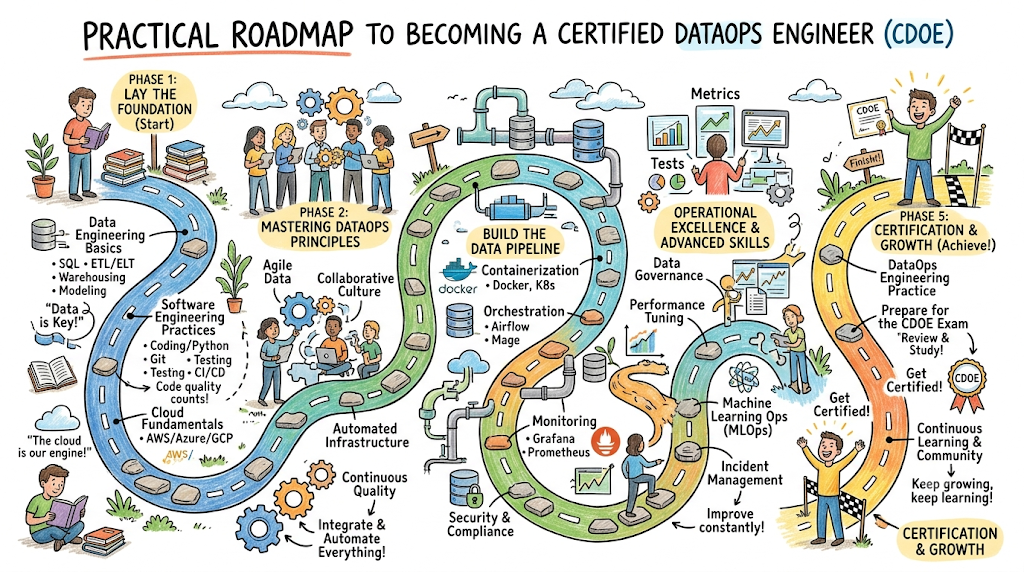
Introduction
In today’s world, data is like fuel for every business. Companies collect data from many tools, platforms, and applications, but they often struggle to move, clean, and use this data in the right way. The CDOE – Certified DataOps Engineer certification helps professionals learn how to manage data pipelines, automate workflows, and make data more reliable for teams like analytics, AI/ML, and business operations. This certification is designed to turn you into a skilled DataOps engineer who understands both tools and processes in a practical, hands-on way.
What it is
The CDOE – Certified DataOps Engineer is a role-based certification that validates your skills in DataOps, data pipelines, automation, testing, and observability for data systems. It is designed to ensure that you can design, implement, and manage data workflows that are fast, reliable, secure, and repeatable. The certification bridges the gap between data engineering, DevOps, and analytics teams.
Who should take it
This certification is suitable for:
- Data Engineers who want to move into DataOps roles.
- DevOps Engineers who want to work closely with data platforms and pipelines.
- Cloud and Platform Engineers who manage data infrastructure and services.
- Analytics Engineers, BI Developers, or ETL Developers who want to modernize their workflows.
- SREs and AIOps professionals who want to build reliable and observable data systems.
- IT professionals who want to specialize in DataOps as a career path.
CDOE – Certified DataOps Engineer Certification Overview
The CDOE – Certified DataOps Engineer certification is designed to be practical, project-driven, and aligned with real industry needs. It focuses on how to apply DataOps principles to design and maintain data pipelines across on-prem, cloud, and hybrid environments. Instead of just theory, it emphasizes hands-on labs, use cases, and scenarios that are close to what you will see in actual companies.
Program delivery, platform, and structureThe CDOE – Certified DataOps Engineer program is delivered via an official online course provided by DataOps School and hosted on their learning platform. The course is structured into modules that cover DataOps fundamentals, data pipeline design, automation, testing, CI/CD for data, monitoring, security, and governance. Each module includes explanations, examples, and practical exercises to build confidence with tools and workflows.
Certification levels, assessment approach, ownership, and structure
The certification is organized in a simple and practical way so learners can follow a clear journey:
- Certification levels:
The path usually starts with core DataOps knowledge and then deepens into advanced and specialized topics. You can treat it as a professional-level certification focused on hands-on skills rather than just beginner theory. - Assessment approach:
The assessment typically includes scenario-based questions and practical evaluation that checks your understanding of DataOps concepts, pipeline design, automation steps, testing strategies, and real-world problem solving. The focus is on what you can do, not just what you can memorize. - Ownership:
The certification is owned and managed by DataOps School, which defines the curriculum, exam pattern, and certification policies. They maintain and update the content to align with current DataOps tools and market needs. - Structure in practical terms:
You learn concepts in short modules, apply them in labs or projects, and then demonstrate your skills through an exam or project-based assessment. The structure is built to help working professionals learn step by step without feeling overloaded.
Skills you’ll gain
After preparing for and completing the CDOE – Certified DataOps Engineer certification, you can expect to gain skills such as:
- Understanding DataOps principles, culture, and lifecycle.
- Designing end-to-end data pipelines across multiple tools and platforms.
- Implementing CI/CD for data workflows and ETL/ELT processes.
- Applying version control and automation to data transformations and workflows.
- Building automated data quality checks and tests for pipelines.
- Setting up monitoring, logging, and observability for data pipelines.
- Working with cloud data services and modern data stack components.
- Collaborating effectively with DevOps, analytics, and data science teams.
- Managing security, access control, and governance in data pipelines.
- Troubleshooting failures and improving reliability of data workflows.
Real-world projects you should be able to do after it
After completing the CDOE – Certified DataOps Engineer certification, you should be able to handle real-world projects such as:
- Building an automated data pipeline that ingests, cleans, and loads data into a data warehouse or data lake on a schedule.
- Setting up CI/CD for data workflows using version control, pipelines, and automated deployment of data jobs.
- Implementing data quality checks that validate data schemas, completeness, and business rules before data is published.
- Creating monitoring dashboards and alerts for data pipelines to detect delays, failures, or anomalies.
- Migrating manual, script-based data processes to automated, repeatable DataOps workflows.
- Integrating data pipelines with analytics tools, dashboards, or machine learning workflows.
- Managing access control and compliance for data used across teams and projects.
Common mistakes
When preparing for and working as a DataOps engineer, learners and professionals often make some common mistakes:
- Focusing only on tools and ignoring DataOps culture, communication, and collaboration.
- Building pipelines without proper version control and documentation.
- Ignoring testing and releasing data changes directly into production without validation.
- Not setting up monitoring or alerts, which leads to silent failures and broken reports.
- Overcomplicating architecture with too many tools instead of keeping it simple and reliable.
- Treating DataOps as just DevOps for data, instead of understanding data-specific challenges.
- Underestimating data quality issues and assuming source data is always correct.
Best next certification after this
Once you complete the CDOE – Certified DataOps Engineer certification, the best next certification depends on your long-term career direction:
- If you want to go deeper in data platforms and automation, choose an advanced DataOps or data engineering certification.
- If you want to connect DataOps with AI and ML workflows, you can move towards AIOps/MLOps certifications.
- If you want to step into broader platform or reliability roles, you can explore SRE or DevOps-focused certifications.
Complete CDOE – Certified DataOps Engineer certification track table
Below is a sample certification track table for the DataOps space. This is a conceptual structure to help you understand how a track could be organized:
| Track | Level | Who it’s for | Prerequisites | Skills Covered | Recommended Order | |
|---|---|---|---|---|---|---|
| DataOps | Foundation / Associate | Beginners in data, DevOps, or cloud who want to enter DataOps | Basic Linux, scripting, and cloud concepts | DataOps basics, data pipelines overview, CI/CD concepts, version control, fundamentals of data quality | Start here if you are new to DataOps | |
| DataOps | Professional (CDOE – Certified DataOps Engineer) | Working professionals who want a hands-on DataOps engineer role | Some experience in data engineering, DevOps, or cloud; understanding of databases and ETL | End-to-end DataOps, pipeline design, automation, testing, monitoring, observability, governance | Take after foundation level or equivalent experience | |
| DataOps | Advanced / Specialist | Senior engineers or leads handling complex data platforms | Professional level knowledge of DataOps and strong experience in production | Large-scale data platforms, multi-cloud pipelines, advanced observability, governance and compliance, architecture | Take after professional level or real-world experience as DataOps engineer |
Choose your path – 6 learning paths
To build a complete career in modern engineering and operations, you can think in terms of learning paths. Here are six useful paths:
- DevOps: Focus on CI/CD, automation, infrastructure as code, containers, Kubernetes, and continuous delivery. Good for roles that manage software delivery and infrastructure.
- DevSecOps: Focus on integrating security into DevOps pipelines, shift-left security, compliance, and secure SDLC. Good for engineers who want to blend security with automation.
- SRE: Focus on reliability, SLIs/SLOs, error budgets, incident management, and observability. Best for roles that own uptime and performance.
- AIOps/MLOps: Focus on automating operations for AI/ML systems, model deployment, monitoring, and feedback loops. Great for data science and ML-heavy environments.
- DataOps: Focus on data pipelines, data quality, DataOps culture, and collaboration between data, DevOps, and analytics teams. Ideal for data-focused engineers.
- FinOps: Focus on cloud cost management, budgeting, optimization, and financial accountability in cloud environments. Useful for teams managing large cloud bills.
Role → Recommended certifications mapping
Here is a simple mapping of roles to recommended certification directions:
| Role | Recommended certifications / tracks |
|---|---|
| DevOps Engineer | DevOps track certifications, container and Kubernetes certifications, cloud platform certifications (AWS/Azure/GCP), and cross-skill with DataOps or SRE. |
| SRE | SRE-focused certifications, observability and monitoring certifications, cloud platform certifications, plus DataOps or AIOps for data-heavy systems. |
| Platform Engineer | Kubernetes and cloud-native certifications, infrastructure as code, platform engineering or internal developer platform certifications, and DataOps for platform-integrated data services. |
| Cloud Engineer | Cloud vendor certifications (AWS/Azure/GCP), DevOps fundamentals, networking and security, and optional DataOps or FinOps to manage costs and data services. |
| Security Engineer | DevSecOps certifications, cloud security certifications, governance and compliance certifications, and secure pipeline-focused training. |
| Data Engineer | Data engineering certifications, CDOE – Certified DataOps Engineer, cloud data platform certifications, and MLOps or AIOps if working with ML teams. |
| FinOps Practitioner | FinOps certifications, cloud vendor cost management certifications, and supporting DevOps/Cloud fundamentals to understand infrastructure spend. |
| Engineering Manager | Leadership-oriented certifications related to DevOps, SRE, or DataOps strategy, along with high-level cloud, security, and FinOps knowledge to manage teams and budgets. |
List of top institutions which provide help in training cum certifications for CDOE – Certified DataOps Engineer
There are several institutions that provide training, guidance, and support for DataOps and related certifications, including topics that align with the CDOE – Certified DataOps Engineer skill set. DevOpsSchool offers structured DevOps and DataOps learning paths with hands-on labs and project-based training. Cotocus focuses on corporate and individual upskilling with tailored programs across DevOps, DataOps, and cloud-native technologies. Scmgalaxy provides workshops, coaching, and learning material for source control, release management, and modern engineering practices. BestDevOps aggregates high-quality DevOps and DataOps courses and helps learners choose the right path. Devsecopsschool specializes in secure DevOps practices, which complement DataOps in regulated environments. Sreschool focuses on Site Reliability Engineering concepts that align closely with reliability and observability in DataOps. Aiopsschool offers learning around AIOps and intelligent operations, which often integrate with data-centric workflows. Dataopsschool is dedicated to DataOps-focused certifications like CDOE and practical training for data pipelines and operations. Finopsschool provides focused education on cloud cost management, which is important when building large-scale data platforms in the cloud.Next certifications to take (3 options: same track, cross-track, leadership)
You can think of your next step after CDOE – Certified DataOps Engineer in three directions:
- Same track (DataOps deepening): An advanced DataOps or data engineering certification that goes deeper into architecture, multi-cloud data platforms, and large-scale data operations.
- Cross-track (adjacent skills): A certification in AIOps/MLOps, SRE, or DevOps to connect DataOps with broader engineering and operations capabilities.
- Leadership (management and strategy): A leadership-oriented certification or program focused on engineering management, technology strategy, or platform leadership, where you learn how to run teams and programs that include DataOps, DevOps, and SRE.
FAQs on CDOE – Certified DataOps Engineer
- What is the CDOE – Certified DataOps Engineer certification?
The CDOE – Certified DataOps Engineer certification is a professional credential focused on DataOps practices, tools, and workflows for building and operating reliable data pipelines in real-world environments. - Who should consider taking the CDOE – Certified DataOps Engineer certification?
This certification is ideal for Data Engineers, DevOps Engineers, Cloud Engineers, Platform Engineers, SREs, and analytics professionals who want to specialize in DataOps and data pipelines. - What skills are tested in the CDOE – Certified DataOps Engineer exam?
The exam typically tests your understanding of DataOps principles, data pipeline design, automation, CI/CD for data, data quality, monitoring, and collaboration between data and operations teams. - Do I need strong programming skills before starting the CDOE – Certified DataOps Engineer journey?
Basic scripting and familiarity with data tools, databases, and pipelines are helpful, but the main focus is on workflows, automation, and operations, not only on heavy coding. - How does CDOE – Certified DataOps Engineer help in my career?
It helps you prove that you can manage real-world data pipelines, automate processes, and work across data, DevOps, and analytics teams, which makes you valuable for data-driven organizations. - Is CDOE – Certified DataOps Engineer suitable for beginners?
It is best suited for professionals with some background in data, DevOps, or cloud. True beginners can start with a foundation-level course and then move to CDOE when comfortable. - What kind of projects will I work on while preparing for CDOE – Certified DataOps Engineer?
You will typically work on building and automating data pipelines, implementing tests and quality checks, setting up monitoring, and integrating pipelines with analytics or reporting systems. - How long does it take to prepare for CDOE – Certified DataOps Engineer?
The time depends on your background, but many working professionals can prepare over a few weeks to a couple of months by consistently following the course, doing labs, and reviewing concepts. - Can CDOE – Certified DataOps Engineer help me move into data-centric roles from DevOps or cloud?
Yes, it is a strong bridge for DevOps or cloud engineers who want to move into data-focused roles and work more closely with data engineers, analytics teams, and data platforms. - What should I focus on most when preparing for CDOE – Certified DataOps Engineer?
Focus on understanding DataOps culture, building end-to-end pipelines, using automation and CI/CD, implementing data quality checks, and setting up observability for data workflows.
Why choose DataOps School?
Choosing DataOps School for your DataOps journey makes sense if you want focused, practical, and industry-aligned learning. Their content is designed around real DataOps challenges, not just theory, which helps you build skills that match what companies expect from a DataOps engineer. The courses emphasize hands-on exercises, projects, and examples that mirror everyday work in data-driven organizations. Because they specialize in DataOps and related areas, they can offer more depth, structure, and clarity across your learning path, from fundamentals to the CDOE – Certified DataOps Engineer level and beyond.
Conclusion
The CDOE – Certified DataOps Engineer certification is a powerful way to build a strong career in modern data operations. It teaches you how to design, automate, and maintain reliable data pipelines that support analytics, AI, and business decision-making. By combining DataOps concepts with hands-on skills and clear learning paths, this certification helps you stand out as a professional who can connect data, DevOps, and cloud in a practical way. If you are serious about working with data at scale, this certification is a strong step toward becoming a trusted DataOps engineer.
